Stanford University has published the ‘ World’s Top 2% Scientist List ’, a ranking of the most cited researchers in the world, in all areas of knowledge. This ranking is based on Scopus data provided by Elsevier. In this latest edition, the list has grown to include more than 230,000 researchers in the career ranking and more than 236,000 in the last year ranking, from 26,984 universities and research centres in 168 countries. Once again, we are proud to announce that four researchers on this list are part of CEIGRAM, adding to a total of 66 researchers from the Universidad Politécnica de Madrid who have been recognised.
The World’s Top 2% Scientists List generates two rankings: the first considers the researcher’s entire career, and the second considers the results from the last year. This ranking evaluates multiple indicators, such as the H-index, the co-authorship-adjusted HM-index, citations, and co-authorship position, among others. The presence of CEIGRAM research staff in this ranking demonstrates the relevance of the studies carried out and their usefulness in the development of new research.
You can see who the recognised researchers are on this list and download the complete list of Top 2% Scientists at the following link: https://topscinet.com/
CEIGRAM RECOGNITION
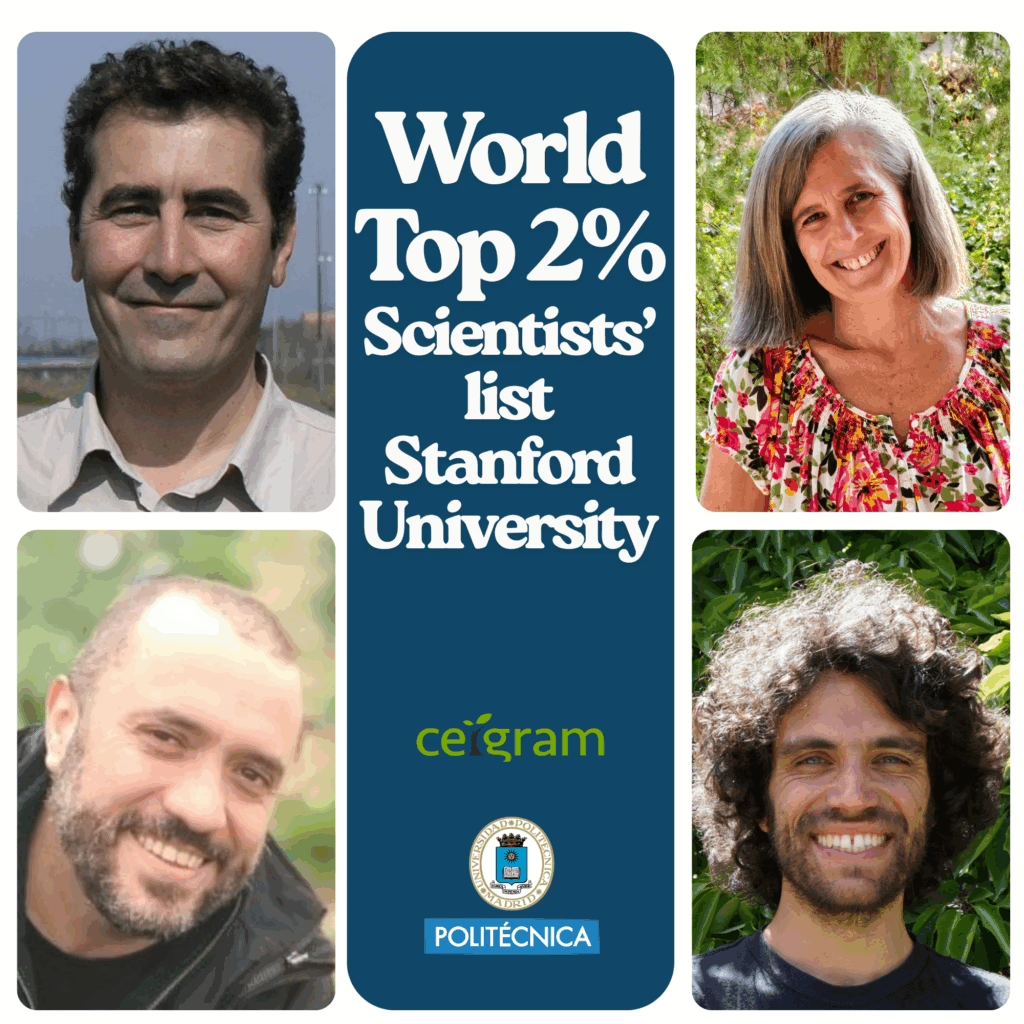
The CEIGRAM research staff who have been included in the list of recognition for their research careers include Professors Miguel Quemada and María Gómez del Campo.
On the other hand, the list recognising citations obtained in the last academic year once again includes Miguel Quemada and María Gómez del Campo, but also Alberto Sanz-Cobeña and Luis Lassaletta.
Below you can read a brief description of the personal profiles of each of the researchers who have received this recognition:
Miguel Quemada. University Professor in the Department of Agricultural Production at the Polytechnic University of Madrid since 2008, he obtained his PhD in Agronomy at the University of Georgia (USA) in 1995, and over the last 30 years, his lines of research have focused on the development of strategies based on water and nitrogen management to maintain the sustainability of cropping systems under current and future conditions. He has coordinated several national and international projects and participated in numerous agreements with fertiliser and agri-food companies. He was coordinator of the
Professor Quemada has an h-index (Scopus) of 45 and has published 120 articles, most of them in high-impact journals, which have been cited a total of 5,760 times. His publications have been particularly relevant in fields such as: cover crops, remote sensing, vegetation index, environmental impact assessment and nitrogen cycle.
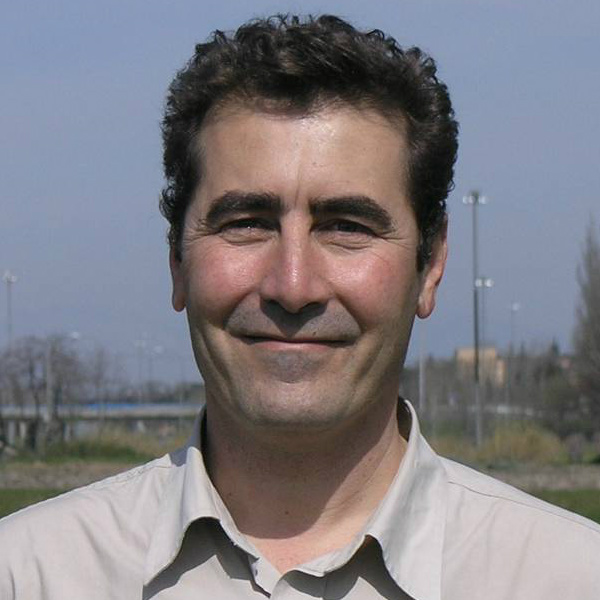
María Gómez del Campo. Lecturer in the Department of Agricultural Production at the Universidad Politécnica de Madrid since 2001 and Full Professor since 2020. She teaches courses on fruit tree and olive tree cultivation. Secretary of the Master’s Degree in Precision Agriculture.
In her doctoral thesis (1998), she evaluated the response of vine varieties to water availability. She specialised in olive cultivation while working at the University of Seville between 1997 and 2001. Since then, her research activity has focused on the development of deficit irrigation strategies and olive grove design. She is currently leading an interdisciplinary group on precision fertilisation of olive groves.
According to Scopus, María has an h-index of 24, has published 55 articles, mostly in high-impact journals, and has been cited a total of 1,058 times. Several of her articles report the results of field trials lasting more than eight years. Her publications have been particularly relevant in fields such as Olive, Irrigation, Remote Sensing, Soil Moisture, and Vitis vinifera.
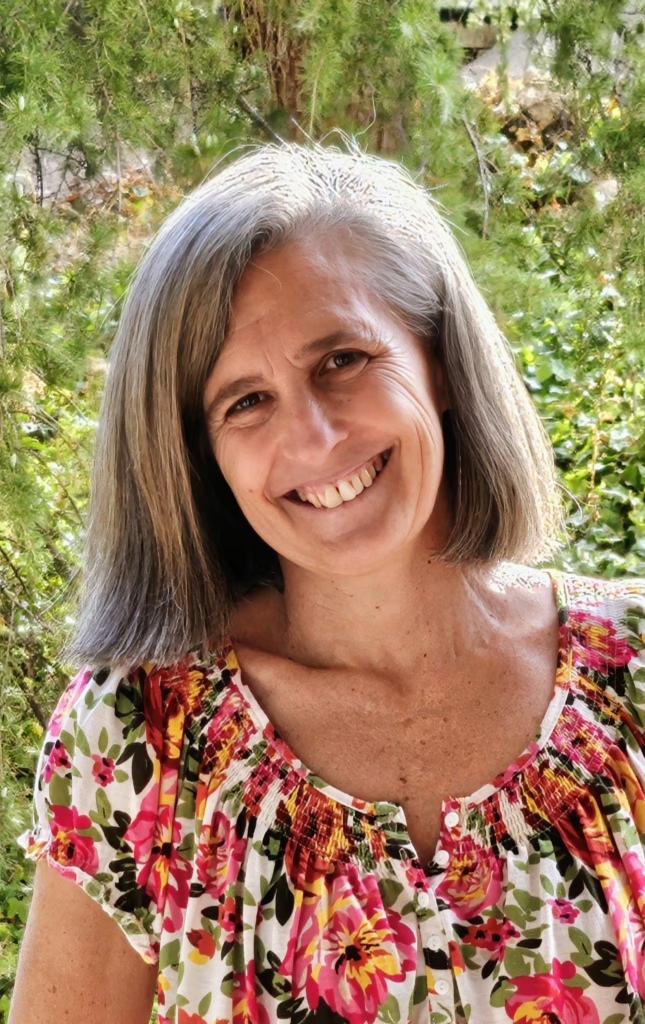
Luis Lassaletta Coto. Doctor of Science from the Complutense University of Madrid (2007), he has focused his career on studying the sustainability of agricultural systems in relation to nutrient cycles and greenhouse gas emissions. He spent almost eight years between the Sorbonne University in Paris, the CNRS (France) and the Netherlands Environmental Assessment Agency (PBL). In 2018, he joined Prof. M. Quemada’s group (AgSystems) at the Universidad Politécnica de Madrid as a Ramón y Cajal researcher. He is currently an Associate Professor (Programme l3).
Without leaving the field of global agronomy, he currently focuses his scientific activity on studying the particularities of the Mediterranean region with regard to nutrient management in agroecosystems in the context of climate change and the risk of contamination and loss of soil fertility, using modelling tools and nutrient balances, the analysis of historical trajectories and the generation of management scenarios, including the reconnection between crops and livestock. He has participated as an expert in various international scientific panels such as the European Union Nitrogen Panel (EUNEP), the European Commission’s Knowledge Hub on Water and Agriculture (2020) and the United Nations global INMS project, leading the task on nitrogen use efficiency and for the FAO. He is currently the Director for Europe of the International Nitrogen Initiative.
Luis Lassaletta has an h-index of 40 (Scopus, excluding self-citations) and has published 85 articles, generating more than 9,000 citations, several of which are highly cited, including in journals such as Nature, Nature Climate Change, Nature Sustainability, Nature Food, and PNAS.
Alberto Sanz-Cobeña. Full Professor in the Department of Food Chemistry and Technology at the UPM. His research focuses on the study and analysis of strategies to mitigate nitrogen losses associated with agricultural production. The use of process models, together with experimental data obtained under real conditions during his research activity, is enabling estimates to be made of medium- and long-term agri-environmental impacts in various agricultural systems and under different management strategies.
In addition, he has sought a more integrated view of a complex problem such as greenhouse gas emissions in the agri-food system and other nitrogen compounds and their mitigation. Without abandoning the generation of quality empirical data at the plot level, he has led other studies focused on the provincial, river basin, national and large region (Mediterranean) levels. He also has a special interest in the impact that changes in habits, both in production and consumption, can have on increasing the sustainability of agri-food systems at different scales. He has been the principal investigator for projects at the national and European level (AgroGreen-SUDOE, 2021-2023) and coordinates, together with Luis Lassaletta, the AgrosceNa-Lab line of research at CEIGRAM.
His work and the international network of collaborations he has built up over the last decade, within the framework of collaborative projects and initiatives, as well as stays abroad, have led him to publish, according to Scopus, 82 articles that have been cited a total of 4,200 times (excluding self-citations), giving him an h-index of 35 (WoS). Alberto has been president of the Scientific Network for GHG Mitigation in the Spanish Agroforestry System (Red REMEDIA, 2022-2024) and an active member of international scientific initiatives such as the UNECE Technical Panel on Reactive Nitrogen (TFRN), where he is currently coordinating the revision of the guidance document on ammonia mitigation in agricultural systems. He was the lead author of the report on environmental and climate risks in the Mediterranean (MEDECC) and is currently (2025-2027) the lead author of the IPCC.
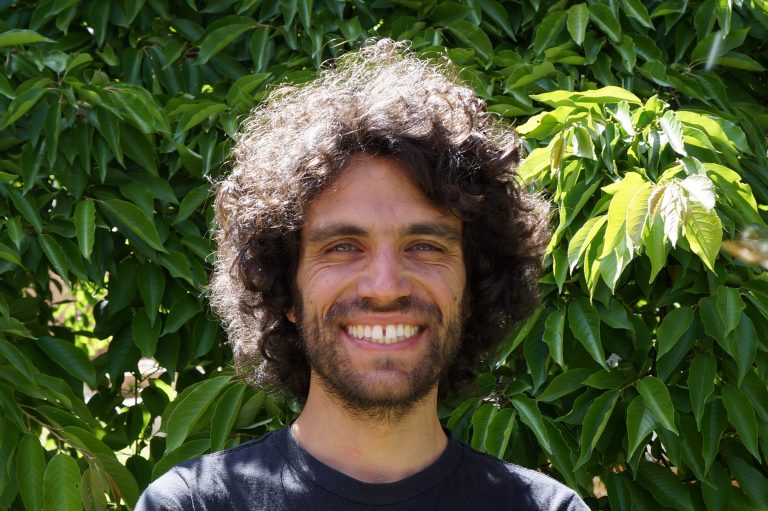
The recognition of these four researchers reaffirms the importance of the work we do at CEIGRAM. It highlights the quality and impact of their research on such important issues as agricultural sustainability, the fight against climate change and efficient resource management, key areas for addressing current global challenges.