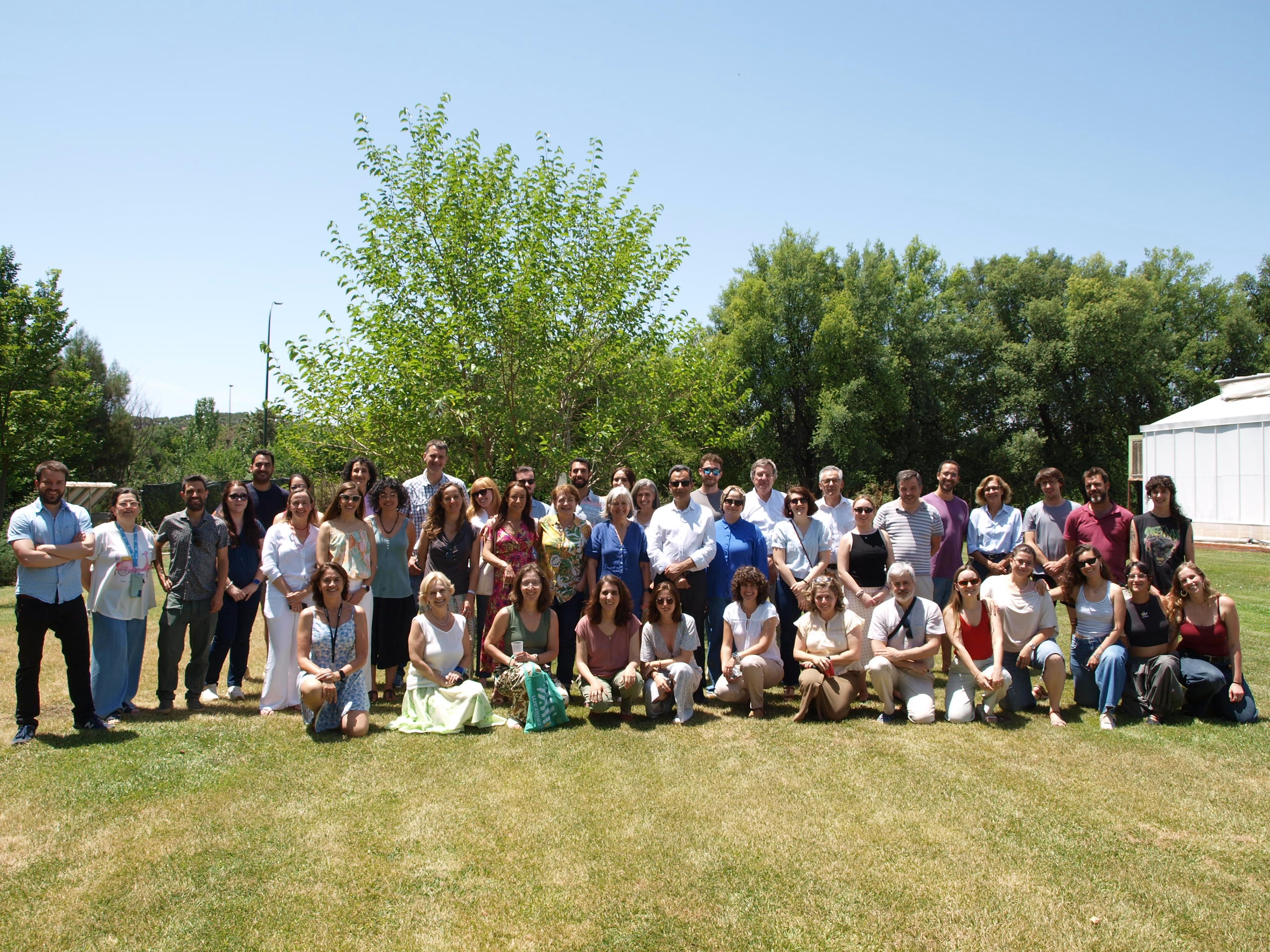
On June 12, 2026, Joseba Lizarralde Echaniz defended his doctoral dissertation with international distinction at the University of Zaragoza. The dissertation, titled “Assessment of the resilience of small ruminant farming systems in Spain,” was supervised by Bárbara Soriano, a researcher at CEIGRAM and professor at the UPM, and Nerea Mandaluniz, a researcher at NEIKER.
This dissertation was completed as part of the doctoral program in Agricultural and Environmental Sciences at the University of Zaragoza, and was carried out as part of the RUMIRES research project (Project PID2020-120312RA-I00), funded by the Ministry of Science, Research, and Universities and the State Research Agency, and led by Daniel Martín Collado, a researcher at the Aragon Center for Agri-Food Research and Technology (CITA).
The thesis evaluates how small ruminant farms are facing a series of highly relevant challenges today, such as rising temperatures, an increase in wildlife, changes to the Common Agricultural Policy (CAP), shifts in consumption patterns, and political and geoeconomic instabilities such as the COVID-19 pandemic and the war in Ukraine. It also identifies the characteristics of each farm based on a series of resilience indicators, such as access to natural and financial capital, municipal infrastructure, human capital, functional diversity, spatial and temporal heterogeneity, knowledge, and innovation networks, among many others.
There is growing interest in studying the resilience of farms. Typically, studies on resilience focus on the consequences of crises but pay less attention to the characteristics of the system that contribute to building resilience, known as resilience attributes. This is due, in part, to the lack of practical approaches for assessing these attributes. This thesis aims to identify and operationalize resilience attributes into quantifiable indicators that allow for comparisons between different farms.
To this end, the thesis focuses on the analysis of three case studies of small ruminants in Spain: meat sheep farms in Aragón, dairy sheep farms in the Basque Country and Navarra, and dairy goat farms in Andalusia.
Among the most relevant conclusions, it is noteworthy that there are key attributes that should be prioritized to strengthen small ruminant systems, according to the perceptions of farmers and stakeholders: functional and adaptive diversity, autonomy, knowledge and innovation networks, local interdependence, links to natural resources, economic capital, natural capital, and human capital.
It is also important to consider that certain attributes of resilience are specific to the type of farm and the challenges it faces. This means that improving the resilience of small ruminant systems requires taking into account the diversity of farms, understanding the specific challenges each one faces, and adopting policies that strengthen the attributes that promote resilience according to farm type.