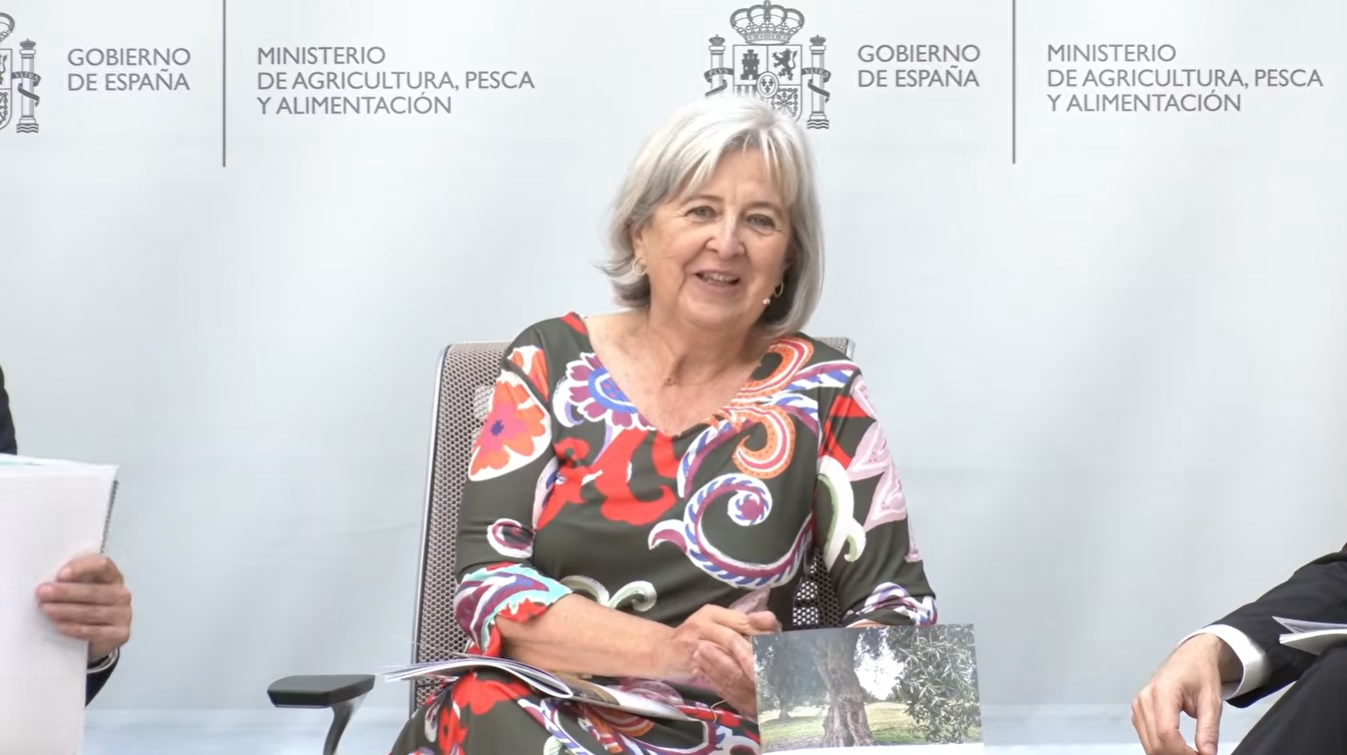
Isabel Bardají attended the Ministry’s commemorative event to highlight the importance that Common Agricultural Policy funds have had in modernizing our agriculture and in research within the agri-food sector, where our School plays a key role.
Original Font: ETSIAAB Sala de Prensa
One of the most significant milestones we have recently celebrated was the 40th anniversary of Spain’s accession to the European Union (an anniversary that fell in June 2025). And, four decades later, if anyone knows firsthand the transformation brought about by joining the “EU club,” it is the agri-food sector, which has undergone a profound modernization since then. Much of the “credit” goes to the Common Agricultural Policy (CAP), which our country joined in 1986 and which, over these four decades, has provided our farmers and ranchers with subsidies totaling 200 billion euros.
To commemorate this anniversary and shed light on the past, present, and future of the CAP (which is now entering a new phase for the 2028–2034 period), the Ministry of Agriculture, Fisheries, and Food (MAPA) has organized an event featuring experts. Among them was Isabel Bardají, a professor at the Higher Technical School of Agricultural, Food, and Biosystems Engineering (ETSIAAB), who participated in a panel discussion where she noted that CAP subsidies “have modernized Spanish agriculture” but have also greatly boosted research in this field.
She noted that our country is the third-largest recipient—behind just France and Germany—of research funding. And this has led to enormous advances: “Agricultural research would not be what it is today without EU funding. And agriculture will not benefit from these advances without research and EU funding,” the professor stated.
Bardají also highlighted other achievements made under the CAP, such as modernization, improved conditions for farmers, and greater competitiveness in the markets, but above all “the incorporation of environmental objectives that cannot be ignored.”
Research and knowledge transfer: the future of the CAP
According to the professor, one of the major future challenges facing the new CAP is generational renewal. Furthermore, in her view, in order to continue moving forward, “technological progress must be inclusive,” and research and knowledge transfer must remain one of the pillars, particularly with regard to water and nitrogen fertilizers.
He highlighted the role of European and national programs that emphasize innovation and knowledge transfer, seeking to foster collaboration between professionals and the scientific community. The Operational Groups account for a small portion of the budget but have a significant impact on the agricultural sector. Research must play a key role in transforming production systems to address current and future challenges.
Joining her at the roundtable discussion were economist and former member of parliament Juan Moscoso, and former Member of the European Parliament Clara Aguilera, who specializes in agriculture, fisheries, and rural development. The event was closed by the Minister of Agriculture, Fisheries, and Food, Luis Planas. All of them highlighted the significant progress our agriculture sector has made since Spain joined the EU, transforming us into an “agrifood powerhouse.”
This event served to launch the publication ‘La Política Agraria Común: un triunfo de Europa, un triunfo para España’, published by the Ministry.