The MORFEO project (‘Management of Organic Fertilisers for the Mitigation of Nitrous Oxide and Nitric Oxide Emissions in Mediterranean Cropping Systems’), PID2021-1250070B-100, has recently been completed. This project has concluded after three years of research aimed at improving the sustainability of agricultural systems through more efficient use of nitrogen and reduction of reactive N emissions.
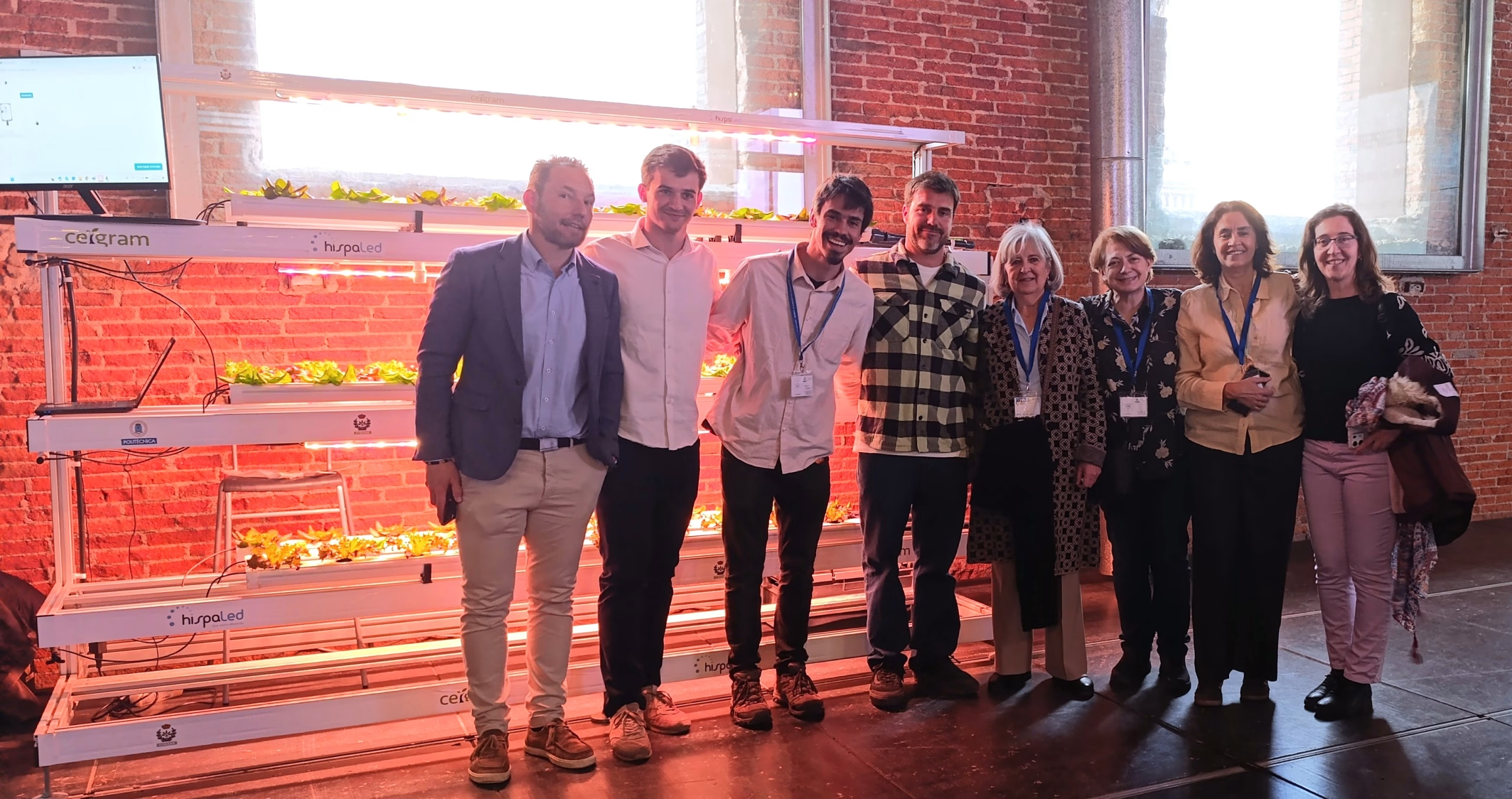
The initiative, developed between 2022 and 2025, has been led by Antonio Vallejo and Sonia García Marco, with the participation of PhD students Susana Iglesias Díez and Alba Monistrol. It has been developed at ETSIAAB through the Group on Agrosystem Pollution from Agricultural Practices (COAPA), attached to the Department of Food Chemistry and Technology at ETSIAAB-UPM and CEIGRAM.
Mitigation of reactive nitrogen: a key environmental challenge
Reactive nitrogen derived from the use of agricultural fertilisers is one of the main factors contributing to soil, water and atmospheric pollution. The project has led to advances in understanding the processes involved in the N cycle (reactive N emissions and NUE) in cropping systems through the management of crop residues, fertilisation (organic and mineral) and water, with a view to studying agricultural practices that improve crop sustainability.
Methods and Results
The project has combined field trials that seek to represent the reality of farming systems in Spain with mechanistic studies, also conducted in the field, using techniques based on 15N and genes associated with nitrification and denitrification.
The main achievements of the project have been:
- Improving the synchronisation of N supply from organic sources to irrigated and non-irrigated crops, which is one of the main challenges currently facing the improvement of N use efficiency (NUE). Information has been obtained on the N supplied to the following crop by maize stubble, buried cover crops and various organic sources (solid and liquid). In fertirrigated crops, strategies based on the application of basal manure and labile organic sources have been developed to supply the N required for the phenological stages of highest demand in horticultural crops.
- N2O and NO emissions have been quantified for each fertilisation practice (organic, green manure, organic-mineral mixtures) both during cultivation and post-harvest. This has enabled the selection of fertilisation practices that are well synchronised with cultivation and produce lower emissions than those obtained with traditional fertilisation. With regard to NO, it has been concluded that the incorporation of organic fertiliser (alone or mixed with mineral fertiliser) constitutes an emissions mitigation strategy. With regard to N2O, the best synchronised practices also tend to produce lower emissions. The results of this project also indicate that post-harvest N2O emissions are significant in rainfed crops, especially when fertilised with organic matter, which limits mitigation.
- Long-term trials (19 years) have concluded that total N2O emissions in organic farming were higher (14%–27%) than in conventional farming as a result of greater N availability throughout the growing season, especially during the intercropping period and/or in seasons with very low rainfall. It has also been shown that total N2O emissions during the transition from conventional to organic farming are significantly higher (45%–76%) than in the conventional system, which should be taken into account in proposals for transitioning to this system.
- Mechanistic knowledge of emissions associated with organic inputs has been deepened through the use of 15N techniques and nitrifying and denitrifying genes, which represents a significant scientific advance.
Funding
The MORFEO project (ref. PID2021-1250070B-100) is funded by MCIN/AEI/10.13039/501100011033/ ERDF, EU.